
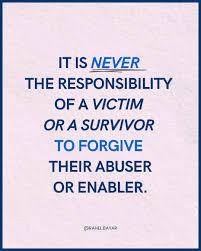
You’re wondering why you’re struggling to forgive. You’ve been taught your whole life to forgive, to turn the other cheek and that by offering forgiveness it somehow makes you closer to the Divine, to God and to being a better person. You have been told your lack of forgiveness is because you’re holding onto resentment. The truth is, you not being able to forgive your abuser is because your subconscious is protecting you from repeating the same karmic wound. Your soul is refusing forgiveness because it knows a truth your ego is still avoiding, Your deeper consciousness pushes back against forgiving the narcissist,
That resistance is a sign of awakening, not weakness.
Part One: Forgiveness without awareness becomes self betrayal
Deep down, you know you cannot be deceived. In Jungian depth psychology, the higher self is not your personality, your ego or your emotional reactions. It is the clear, instinctive, archetypal center of your psyche—the part that perceives the truth without distortion.
This is exactly why your higher self refuses to forgive the narcissist: because it sees what your everyday ego does not want to admit. It sees the shadow behind charm, the emptiness behind confidence, and the manipulation behind affection.
When interacting with a narcissist, you may become fascinated by their intensity, their charisma and the illusion of emotional intimacy they create. But your higher self is never fooled.Your higher empathic self is scanning them and informing your instinct for truth, like a compass guiding you to what is built on falseness.
And, narcissists exist in falseness, constructing a facade designed to hide their profound insecurity and emotional emptiness. You witness the discrepancy, where others fail to see it.
It’s why often the scapegoated sibling and the golden child sibling have two completely different viewpoints of the same circumstance and experience with the narcissistic mother.You felt uneasy while the golden child was captivated. You felt the day out with the narcissist was “off” while the golden child thought it was a prefect day.
This dichotomy often leaves you feeling unsafe and untethered, with no ally to identify with.
Jung taught that everyone carries a shadow—the disowned parts of the self—but the narcissist’s shadow functions in a uniquely destructive way. Instead of confronting their own fear, shame, or inadequacy, they project it onto the nearest target. They attack you for traits they secretly despise in themselves, accuse you of emotions they refuse to acknowledge, and judge you for insecurities they are too fragile to face. Your higher self recognizes this inversion immediately because it violates the basic laws of psychological integration: what is rejected inward inevitably becomes weaponized outward.
I recently had a conversation with my mother. I told her I wanted to explore why it was we hadn’t seen each other in 10 years, and why she refused to attend my wedding and perhaps why it appears she is giving a former family member preferential treatment over her own daughter. Rather than having he ability to explore deeply her own insecurities, she simply shut me down and said “Are we going to have a fight?”
Your wounded ego keeps hoping for the narcissist to show depth or remorse, something that would trigger forgiveness in you, but a narcissist cannot offer real love because they are severed from their authentic self. They cannot see you, respect you, or relate to you in any genuine mutual way. Everything they give is conditional, performative or manipulative—fuel for their false self, not nourishment for a relationship. So when your ego asks, “Why can’t I let them go? Why do I want them to change? Why does forgiving them feel impossible?” The answer is because you are asking for something they are structurally incapable of giving.
Forgiveness without awareness becomes self-betrayal.
We are wired to seek balance. When something threatens your psychological stability, your higher self acts like an internal guardian, refusing to allow you to return to what harms you.
This inability to forgive may translate as bitterness to the outside world. That inner resistance you feel, the inability to truly forgive no matter how much your rational mind tries, is not a flaw. It is your refusal to negotiate with illusion.
When love becomes a trap, remorse a performance, and promises are strategies, it is consciously impossible to forgive a person who shows you a mask because there is no authentic self behind it to reconcile with.
Part Two: Parasites don’t need your forgiveness
The narcissist does not simply hurt you through their actions. They wound you through psychic infiltration. A dangerous unconscious exchange begins—a blending of shadows, vulnerabilities, and projections. With healthy individuals, this exchange leads to growth. With a narcissist, it becomes a psychological takeover.
The narcissist’s identity is built on a false self—a hollow persona masking deep shame and inner fragmentation. This false self behaves like a psychic parasite, unable to sustain itself, so it latches onto empathic, intuitive people to feed on their emotional energy.
The parasitic narcissist masquerades their agenda through projection, manipulation, love bombing, and emotional inversion. You begin to feel emotions that are not yours. You start to doubt truths you once knew instinctively. You question your value, your intuition, even your memory—because the narcissist needs you to become disoriented in order to maintain control.
Parasites don’t need your forgiveness.
When someone’s unconscious darkness gains influence over another’s conscious identity it’s called shadow possession.
This psychic contamination is not worthy of forgiveness. You were pulled into their unresolved shadow, forced to carry emotions they refused to face, and blamed for wounds that were never yours.
Forgiving someone who shifted their inner chaos onto you is not a spiritual virtue. It is a psychological violation.
The narcissist’s shadow works like a psychological mirror held backwards. Instead of reflecting truth, it distorts everything it touches. When they accuse you of being too emotional, what they truly mean is that they are emotionally empty or in denial. When they say you are too sensitive, it is because they cannot tolerate empathy in themselves. When they say everything is your fault, they are projecting their unbearable fragility not you while simultaneously refusing to look in the mirror and hold themselves accountable.
The narcissist’s shadow slips into your psyche until their voice starts sounding like your own. Your higher self reacts instantly—it recognizes the foreign energy and blocks it like a psychic immune response. Jung understood this as the self restoring balance when the ego becomes entangled with a toxic archetype. The narcissist plays the wounded child-tyrant; you’re pushed into the role of rescuer and guilt-bearer. But your higher self refuses that contract because carrying their shadow derails your individuation.
Individuation demands wholeness, and the narcissist creates fragmentation—splitting your intuition from your logic, your empathy from your boundaries, your self-respect from your emotional truth. Eventually, there’s a quiet inner rupture: your higher self rejects their projections, breaks the psychic contract, and floods you with clarity that feels like anger or detachment. Forgiveness becomes impossible not out of bitterness, but because your soul refuses to absolve someone who weaponized your empathy and turned your vulnerability into their battleground.
Forgiveness requires accountability—something a narcissist cannot and will not offer. And your higher self knows that without truth, forgiveness becomes another doorway back into their shadow.
When someone’s shadow has invaded your psyche, forgiveness is not healing. It is self-erasure. That is the truth your higher self protects you from, even when your ego still longs for closure.
Part Three: Forgiveness Does Not Mean Accepting Abuse
Forgiveness without boundaries is not healing. And, boundaries don’t mean needing space from people who are overbearing. Boundaries also means respect for your feelings and your opinions. Forgiveness without respect or boundaries is self-abandonment.
When you forgive a narcissist, there is no growth. All you are doing is resetting the power dynamic in their favor. It gives them clean access to your emotional energy again. To the narcissist, forgiveness is not a moral act—it is a strategy. It is a reset button that erases their wrongdoing and restores your vulnerability.
When you forgive them prematurely, you return to the role they assigned you: the compliant one, the understanding one, the scapegoat, the supply and the one who can be emotionally manipulated.
It’s no wonder you’re resistant to forgive.
Jung taught that forgiveness is impossible while shadow projection is active, and the narcissist lives entirely through projection. Their shame becomes your fault, their rage becomes your “overreaction,” their instability becomes your “sensitivity.” There is no real relationship here—only a psychological mirage—so your higher self refuses forgiveness because there is nothing genuine to forgive. To “forgive” the mask while the narcissist denies responsibility would mean betraying your own reality and colluding with their distortion, a move that fractures your authenticity and splits you from your inner truth.
Your higher self knows that wounds cannot close while they are still being cut open. The narcissist’s shadow continues to harm you—through manipulation, denial, or the lingering effects imprinted on your nervous system—and forgiving them prematurely only dissolves the boundaries you fought to rebuild. Individuation requires clarity, truth, and self-protection, not spiritualized self-abandonment. This is why your higher self draws a hard line: forgiveness without transformation is regression, and it will not let you regress.
Part Four: Forgiveness Before the Wound Has Healed Guarantees More Wounds
Your higher self does not withhold forgiveness out of anger but out of protection. Jung believed that certain relationships activate archetypal loops—ancient emotional patterns that repeat until you finally see their deeper meaning. A relationship with a narcissist is one of these loops: not random or accidental, but a mirror reflecting unresolved wounds, unconscious fears, and forgotten parts of the psyche. The narcissist becomes a trigger, pulling you into a psychological “karmic” cycle where old injuries—abandonment, invisibility, unworthiness, over-giving, mistaking chaos or insincere love bombing for love—flare open and demand attention. Your higher self refuses forgiveness because the lesson is not complete; the psyche repeats trauma until consciousness breaks the pattern. To forgive while still bleeding would only seal the wound prematurely and guarantee its return.
Your higher self blocks forgiveness until you confront the real questions: Why were you drawn to their behavior? Why did boundaries collapse? Why did chaos feel like connection? Jung taught that the shadow seeks its counterpart, and the narcissist’s grandiosity often resonates with unacknowledged desires to be seen or protected, mirroring earlier relational wounds. That is why the connection feels magnetic, fated, archetypal. But the narcissist was never the destination—only the catalyst. Your higher self refuses reconciliation because it knows you have not yet reclaimed your intuition, boundaries, and inner authority. It recognizes you are still vulnerable to their charm, guilt, or emotional gravity and protects your evolution by holding the door to forgiveness shut until you are fully awake, fully separate, and no longer willing to abandon yourself. Only then does the loop end, and forgiveness becomes liberation rather than betrayal.
Part Five: Forgiveness Is A Choice, Not An Expectation
There comes a quiet but unmistakable moment when something inside you shifts—bitterness dissolves, obsession fades, and the emotional charge that once consumed you finally loosens its grip. This moment isn’t triggered by the narcissist changing; it’s triggered by you. Jung taught that the psyche keeps wounds open until their lesson has been integrated, and your higher self withholds forgiveness until you’ve reclaimed enough of your truth, boundaries, and inner power to close the psychological chapter. When that integration begins, forgiveness stops feeling like surrender and starts feeling like freedom.
As you awaken to the deeper purpose of the relationship, you realize it was never about saving the narcissist—it was about rediscovering yourself. Their behavior activated old wounds: the fear of abandonment, the impulse to overgive, the difficulty setting boundaries, the longing to feel chosen, the belief that love must be earned. Once you see these patterns clearly, the spell breaks. The narcissist loses psychological power: their manipulation no longer reaches you, their charm no longer tempts you, and their validation no longer defines you. Jung wrote that we meet ourselves in a thousand disguises; the narcissist was one of those mirrors, reflecting what you were finally ready to hear.
Forgiveness becomes possible only when it no longer puts you in danger—when it no longer invites you back into self-abandonment. At that point, it becomes an internal release rather than reconciliation, a boundary rather than an opening. Individuation—the process of becoming whole—requires reclaiming yourself from all the forces that once shaped your worth, and once you reach that stage, forgiveness becomes effortless not because the narcissist deserves it, but because you deserve peace. Your higher self wasn’t blocking forgiveness as punishment but as protection. And when the lesson is fully integrated, forgiveness becomes liberation instead of betrayal.
To support us: https://linktr.ee/bookofours